
Long before laboratories, brain scans and modern medication, healers knew something profound: the breath is the body's most direct path to calm.
Yogic sages in India mapped the relationship between breath and mind over 5,000 years ago. Indigenous cultures across the Americas, Africa, and the Pacific Islands wove conscious breathing into ceremony, healing, and rites of passage. Traditional Chinese Medicine spoke of qi, life force, flowing through the body, sustained and directed by the breath. These traditions weren't guessing. They were observing, practicing, and passing down what worked across hundreds of generations. It's always been science.
Modern neuroscience has finally arrived at the same destination. And what it's confirmed is remarkable: the way you breathe has a direct, measurable effect on your nervous system. Not metaphorically, physiologically.
Two Maps, One Territory
In yogic tradition, the breath carries prana, the animating life force that flows through invisible channels within the body called nadis. When prana flows freely, the mind settles and the body heals. When flow is disrupted, by fear, grief, or chronic stress, we become dysregulated. The practice of pranayama (literally, extension of life force) or breathwork was designed to restore that flow.
Slow, conscious breathing, especially a long, deliberate exhale, directly stimulates the vagus nerveand activates the parasympathetic state. Indigenous healers called this returning to center. Neuroscientists call it vagal tone. The experience is the same: the chest softens, the mind quiets, and something in you returns home, homeostasis.
Both explanations are valid, one ancient, one contemporary. They are simply different languages for the same deep truth.
Five Techniques Worth Trying
These practices carry lineages. Some come from ancient yoga. Some echo healing traditions found across many cultures worldwide. All of them have now been studied in clinical settings and found to meaningfully reduce stress, lower cortisol, and support emotional regulation.
You don't need to master all of them. Try one that resonates and stay with it.
4-7-8 Breathing
Rooted in pranayama practice, this technique works through the ratio of breath, a long exhale that is twice the length of the inhale. Inhale through your nose for 4 counts, hold for 7, then exhale slowly through your mouth for 8. The extended exhale is what shifts your system. It tells your nervous system, in a language older than words, that the danger has passed. Many find it most useful before sleep or after a difficult emotional experience.
Belly Breathing (Diaphragmatic Breathing)
Across Indigenous healing traditions worldwide, from Andean curanderismo to Aboriginal Australian ceremony, breath drawn deep into the belly has long been understood as grounding and restorative. Modern life tends to push our breath high into the chest, especially under stress. Belly breathing is an invitation to return, to remember. Place one hand on your chest, one on your belly. Inhale and let the belly rise first. Imagine expanding your ribcage. Exhale and let it fall. Imagine squeezing your ribs together, gently forcing every drop of air out. Physiologically, this engages the diaphragm fully and activates the vagal response. Experientially, it can feel like arriving somewhere safe.
Box Breathing
This symmetrical breathing pattern, inhale for 4, hold for 4, exhale for 4, hold for 4, mirrors the rhythmic, repetitive patterns found in Indigenous drumming, chanting, and ceremonial practice. Rhythm itself is regulating. It gives the anxious mind an anchor and brings the nervous system into coherence. Used widely by people in high-stress environments today, its roots lie in the ancient understanding that pattern and breath together restore balance.
Humming Breath (Bhramari)
In yogic tradition, Bhramari, named after the black Indian bee, has been practiced for millennia as a way to quiet the mind and soothe turbulent emotion. The technique is to: inhale fully, then exhale, lips closed, with a soft, sustained hum focusing on the vibration in the upper palette. The vibration is not incidental. Research suggests it may stimulate the vagus nerve through the tissues of the throat and chest, increasing heart rate variability and deepening the relaxation response. Many Indigenous traditions similarly use toning, chanting, and sound as healing tools, recognizing that vibration moves through the body in ways that words alone cannot reach. Add a bit of rocking, like grandmas and mamas have always done with their sweet babies. If anxiety feels physical for you, tight chest, shallow breath, racing heart, this practice may be particularly helpful.
Alternate Nostril Breathing (Nadi Shodhana)
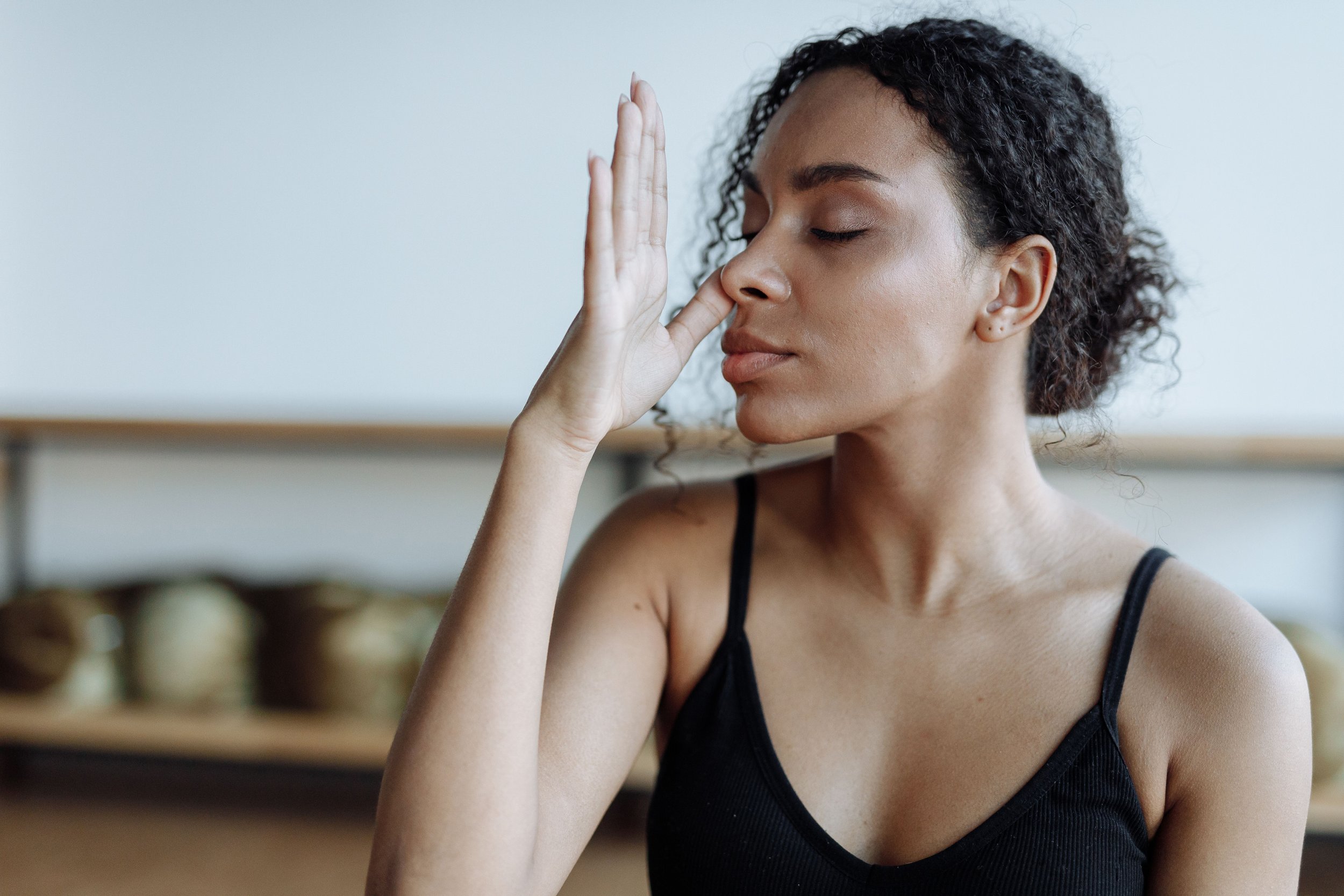
This technique comes from one of the oldest living traditions of breathwork in the world. In yogic philosophy, it balances the ida and pingala nadis, the two primary energy channels associated with rest and activity, lunar and solar, left and right, effort and ease. Close your right nostril with your thumb and inhale through the left. Then close the left with your ring finger, release the right, and exhale through the right. Inhale through the right, switch, exhale through the left. That's one cycle. Research shows it reduces anxiety and supports balanced nervous system function. Ancient practitioners would simply have said: it brings you back into harmony.
Coming Back to Yourself, Remembering
Many Indigenous healing traditions hold that illness, including the kind that lives in the mind and nervous system, is a state of disconnection. From the body, from the community, from the rhythms of the natural world. Healing, in this view, is a return, remembering.
Breathwork is one of the oldest forms of that recall, returning home. It asks nothing of you except presence. No belief system is required, no spiritual framework, no prior experience, this is science. Your nervous system will respond regardless, because this knowledge is written into your biology, passed down not through culture alone, but through the simple fact of being human.
As a complement to your therapy work, breathwork can create a little more space, between the sensation, feeling, narrative and the reaction, between the fear and the response. It can help your body feel safe enough for the deeper, more transformational work to unfold. You can explore how breathwork integrates within Embodied Soul Psychotherapy® as part of a holistic, somatic approach to healing.
Two or three minutes a day, practiced with some consistency, is enough to begin. The ancients didn't need neuroscience. But they had time, attention, and bodies just like yours. They found something true.
Now it's yours to find it, again and again.
I offer somatic, depth-oriented psychotherapy for individuals and couples across California, Washington, Utah, Colorado, Oregon, and Tennessee through virtual therapy. If you are ready to explore how breathwork, the body, and depth-oriented therapy can support your healing, I invite you to reach out.
Frequently Asked Questions: Breathwork and the Nervous System
-
When you extend your exhale, breathing out longer than you breathe in, you directly activate the parasympathetic nervous system through the vagus nerve. This is not metaphor. It is physiology. The vagus nerve, which runs from the brainstem through the heart and into the belly, reads the pace and depth of your breath as a signal about your safety. A long, slow exhale tells it the threat has passed. Ancient traditions built entire practices around this mechanism long before neuroscience had language for it.
-
The vagus nerve is the primary pathway of the parasympathetic nervous system, the part of your nervous system responsible for rest, digestion, and social connection. It is the biological infrastructure of calm. When it is well-regulated, you can think clearly, connect with others, and recover from stress. When it is chronically under-activated, which is common in people carrying trauma or living under sustained pressure, the body stays in a low-grade state of defense. Breathwork is one of the most accessible ways to stimulate vagal tone.
-
There is no single best technique. Different patterns serve different states. For acute anxiety, extended exhale breathing (such as 4-7-8) tends to work quickly by activating the parasympathetic response. For scattered or unfocused anxiety, box breathing offers rhythmic steadiness through equal counts of inhale, hold, exhale, and hold. For a sense of dissociation or disconnection, belly breathing helps restore felt contact with the body. Starting with two to three minutes of any of these, consistently, builds more capacity over time than longer occasional sessions.
-
Breathwork is a meaningful complement to therapy, not a replacement for it. Regulating the nervous system through breath creates a window, a moment of greater capacity, in which deeper therapeutic work becomes more accessible. For people carrying complex trauma or significant dysregulation, breathwork is most effective when held within a broader therapeutic relationship, where activation can be titrated carefully and what surfaces has somewhere safe to land.
-
Yes, and it is worth taking seriously. For some people, particularly those with trauma histories, dissociation, or a nervous system that has learned to distrust stillness, focused attention on the breath can initially increase rather than decrease distress. This is not a sign that breathwork is wrong for you. It is a sign that your system needs a gentler entry point, more titration, and ideally the support of a trauma-informed practitioner who can help you find the approach that works with your nervous system rather than against it.
Further Reading & Sources
Breathwork, Nervous System and Stress Reduction
Frontiers in Public Health (2023). Breathing practices for stress and anxiety reduction: a systematic review of 58 clinical trials | Read the study
Alternate Nostril Breathing (Nadi Shodhana)
Nagendrappa et al. (2025). Alternate nostril breathing and its impact on perceived stress. Asian Journal of Medical Sciences | Read the study
Bhramari Pranayama (Humming Breath)
Bhavanani et al. (2021). Bhramari Pranayama: a lifestyle intervention to reduce heart rate and enhance autonomic function. PMC | Read the study
